
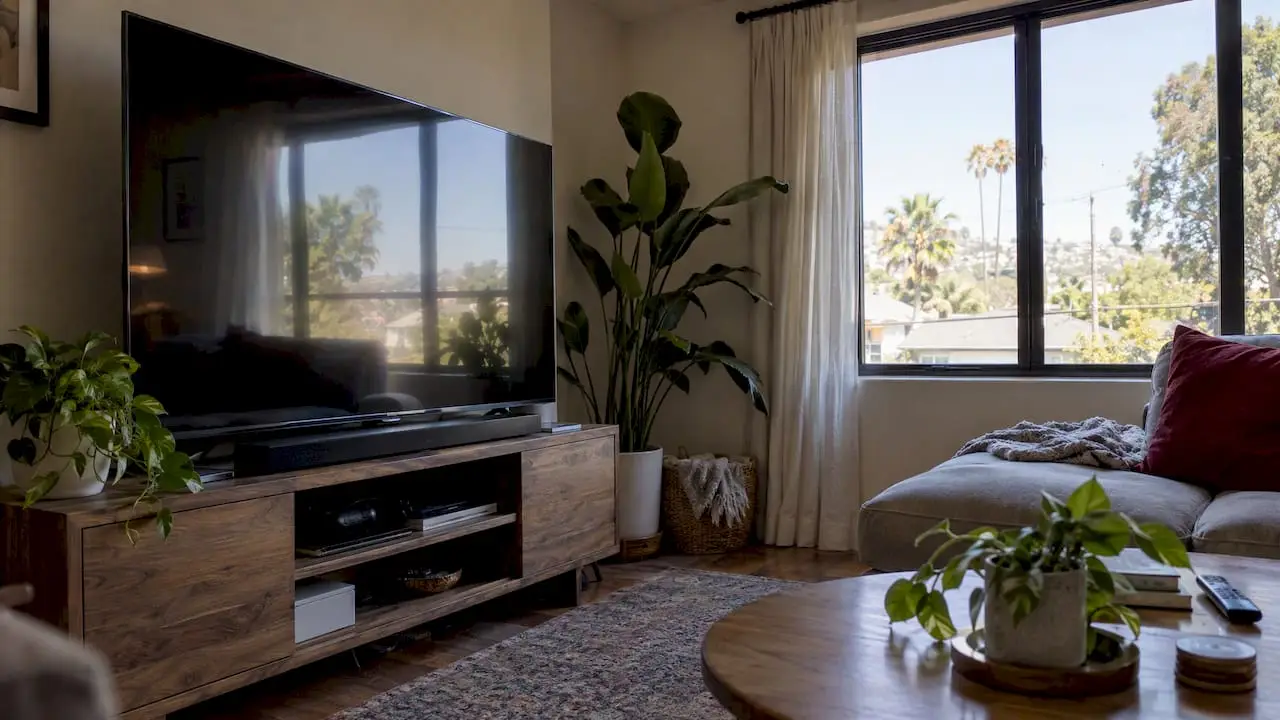
To reduce TV glare from windows, start by finding which window is the culprit, then work through four fixes: move or angle the TV, change the TV’s picture settings, control the light at the window, and treat the glass with film. Most rooms need a combination. Furniture and settings cost little, while window film is the permanent fix when the light itself is the problem.
This guide covers each fix in the order we’d try it, what it can and can’t do, and how to decide when it’s time to treat the glass.
TL;DR
- Glare happens because most modern TVs have glossy screens that act like a mirror for any bright source, and a big window is the brightest source in the room.
- Free fixes first: change the TV’s angle or position, clean the screen, adjust picture mode, and add a soft bias light behind the set.
- If sun still floods the screen, control the light at the window: curtains or blinds help, and window film reduces brightness and reflection without losing your view.
- Anti-glare film made for the TV screen itself exists, but it diffuses reflections instead of removing the light, so it works best as a supporting fix.
- Film choice depends on your climate and window direction, so get a professional recommendation before buying.
Table of Contents
- Why your TV turns into a mirror
- Diagnose the glare before you buy anything
- Free and cheap fixes to try first
- Shade the window: curtains, blinds and their limits
- Window film: the permanent fix for daytime glare
- What about anti-glare film for the TV itself?
- Our perspective: treat the light, not just the screen
- Get your windows treated by a pro
- A simple order of attack
- FAQ
- Sources
Why your TV turns into a mirror
The cause is simple physics. According to CNET, most modern TVs have glossy screens that reflect any light source in a room, from windows to lamps, and some older sets with more matte screens don’t show the same mirror-like reflections. That’s why the TV you loved in the store, under even lighting, can look washed out at 3 p.m. in your living room.
There are two separate problems, and they need different fixes:
- Reflections. You can see the window, or the bright patch of wall opposite it, in the screen. Moving things around, shading the window or changing the screen surface solves this.
- Washed-out picture. Overall room brightness is so high that dark scenes lose contrast. This is solved by reducing the light entering the room or by making the picture brighter.
Knowing which one you have decides how much money to spend. Reflections are often fixed for free. A room that is simply too bright usually needs the window treated.
Diagnose the glare before you buy anything
A few minutes of checking saves a lot of guesswork. TCL’s guide to TV glare suggests identifying the main culprit first, noting that it usually comes down to one dominant light source, even in a busy room. Here’s a practical way to do it:
- Turn the TV off and sit where you normally watch.
- Look at the black screen and note every reflection: a window, a lamp, a bright doorway.
- Repeat at the times you actually watch: morning, mid-afternoon, early evening. The window that causes trouble at 4 p.m. may be a different one than at 10 a.m.
- Close the curtains on that one window and see how much improves.
If closing a single window fixes most of it, you have a window problem, not a TV problem. That’s useful, because it tells you where to focus.
Free and cheap fixes to try first
Change where the TV sits
The Tom’s Guide explainer on TV glare points out that if you can, place the TV away from windows and where overhead lights won’t hit it. Even a small shift helps. Glare is about angle: a window beside the screen reflects far less than a window directly facing it. A TV on a wall perpendicular to the main window is the classic good layout.
If you can’t move the TV, move the seating. Sitting a little off-axis can take you out of the reflection path.
Adjust the picture settings
TCL’s guidance includes raising brightness for daytime viewing and switching to a sports or standard mode in a bright room, rather than staying on a dim cinema preset. Save a separate day and night setting if your TV allows it. This won’t remove reflections, but it makes the picture win the contest with ambient light.
Add bias lighting
A neutral lamp or LED strip behind the TV raises the light level around the screen, which makes dark scenes look deeper and reduces eye fatigue, according to the same TCL guide. Because the light sits behind the set, it doesn’t add a new reflection on the front. Choose a neutral color so it doesn’t tint the picture.
Keep the screen clean
Fingerprints and dust scatter light and make glare look worse. Wipe the screen with a dry microfiber cloth, following your manufacturer’s care instructions.
Shade the window: curtains, blinds and their limits
Curtains and blinds are the usual next step, and they do work. Their downside is that you give up the view and the natural light you probably bought the windows for. One homeowner thread among the top results describes having heat-blocking film and blinds and still finding the TV almost unwatchable, which is a common pattern when the film is chosen for heat only and the blinds are left open for the view.
Some practical notes:
- Blackout or room-darkening curtains are the strongest cheap option for a dedicated media room, but they make the room feel closed in during the day.
- Sheer layered with opaque gives you flexibility: sheers for casual viewing, opaque for movie nights.
- Cellular or roller shades sit close to the glass and block more stray light than slatted blinds, which leak at the edges.
- Exterior awnings or overhangs stop sun before it reaches the glass, but are a bigger project.
Shading has one more effect worth knowing. The U.S. Department of Energy’s study of window attachments found that how and when they’re used depends on climate: closing shades in cooling-dominated climates saves energy consistently, while in northern or central climates it can sometimes raise energy use by blocking helpful solar heat in the heating season. If you live somewhere with real winters, a shade that stays closed all day is not always free.
Window film: the permanent fix for daytime glare
When the light is the issue and you don’t want to live behind curtains, film on the glass is the cleanest answer. A film reduces how much visible light passes through the window, and many also cut reflectivity, so the room stays calmer and less harsh while you can still see outside.
What film does for TV viewing
- Lowers the brightness of the light source. A bright window reflecting in your screen becomes a dimmer window, so the reflection is much less distracting.
- Reduces contrast between the window and the rest of the room. Your eyes aren’t constantly pulled to a glaring rectangle.
- Blocks UV and reduces fading. Sun that washes out your picture also fades floors, rugs and furniture. Film can help with that, which is why it pays off beyond the TV. See our guide to blocking 99% of UV with window tint.
- Adds heat control. Solar control films reduce the heat coming through the glass, a bonus in a sunny west-facing room. Learn more about solar control and heat-reducing film.
What film can’t do
Film lowers glare; it doesn’t erase it. A glossy TV opposite a large, still-bright window may still show some reflection at the worst hour of the day. That’s why we recommend combining film with sensible TV placement. And be careful with sweeping promises. The Federal Trade Commission has pursued companies for unsupported claims, and its warning letter to window marketers states that claims about energy savings or payback must be backed by competent scientific evidence. Treat any installer or brand that guarantees a specific percentage of savings with caution, and judge film mainly on glare, comfort and UV control.
Which kind of film for which room
| Situation | What to look for | Why |
|---|---|---|
| Bright south or west window facing the TV | Neutral or darker solar control film, ceramic if heat is also an issue | Cuts both brightness and heat in the afternoon |
| Bay of large windows, want to keep the view | Lighter, clear-looking ceramic film | Reduces glare and UV while staying natural-looking |
| Neighbors can see in and you also want privacy | Privacy film | Handles daytime visibility into the room as well as brightness |
| Dedicated media room | Darker film plus blackout curtains for movie nights | Maximum control for evening or low-light viewing |
A darker film cuts more glare but also more natural light, and it changes how the room looks from the street. Ask to see samples on your own glass at the time of day you watch TV.
Climate and direction matter
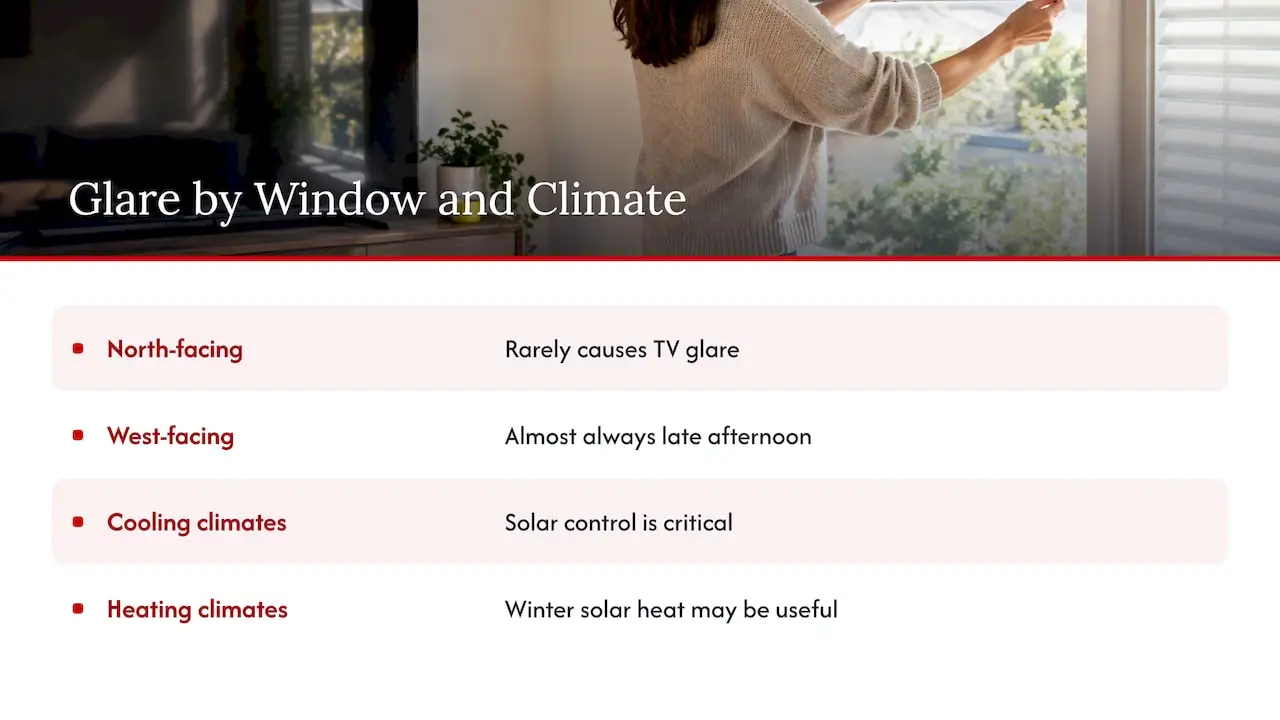
The Department of Energy notes that solar control is critical in cooling-dominated climates but can be counterproductive in heating-dominated areas where winter solar heat is useful, and it advises tailoring the choice to your climate zone and window orientation (see the DOE study above). A north-facing window rarely causes TV glare at all, while a west-facing one almost always will in late afternoon. In a hot place like Southern California, solar control film is an easy call. In a cold climate, it’s worth thinking about which windows you treat.
For a closer look at how film handles heat without leaving the room dark, read how residential window tinting cuts heat and preserves light.
What about anti-glare film for the TV itself?
Searchers often ask whether there’s a film you can put right on the screen. There is. Anti-glare overlays for displays diffuse reflected light so you don’t see a mirror image, and, according to one display film manufacturer, they’re typically applied with dry-application adhesives and can keep roughly 90% light transmission.
A few honest caveats before you try one:
- A matte overlay diffuses reflections, but it can soften sharpness slightly compared with the bare glossy panel.
- Fitting a large sheet bubble-free on a 65-inch TV is hard, and a bad fit is permanent-looking.
- It does nothing about a room that is too bright overall.
- Check your TV warranty and the manufacturer’s care advice before sticking anything to the panel.
Our view: screen overlays suit monitors and smaller displays well. For a living-room TV, fixing the light at the window usually gives a better result and benefits the whole room.
Our perspective: treat the light, not just the screen
We tint glass for a living, mostly in Los Angeles, and the same pattern comes up with homeowners. They’ve bought a new TV, tried a lamp and a bigger remote of settings, and still can’t watch a game at 4 p.m. because the window is doing the damage. The TV is rarely the problem. The window is.
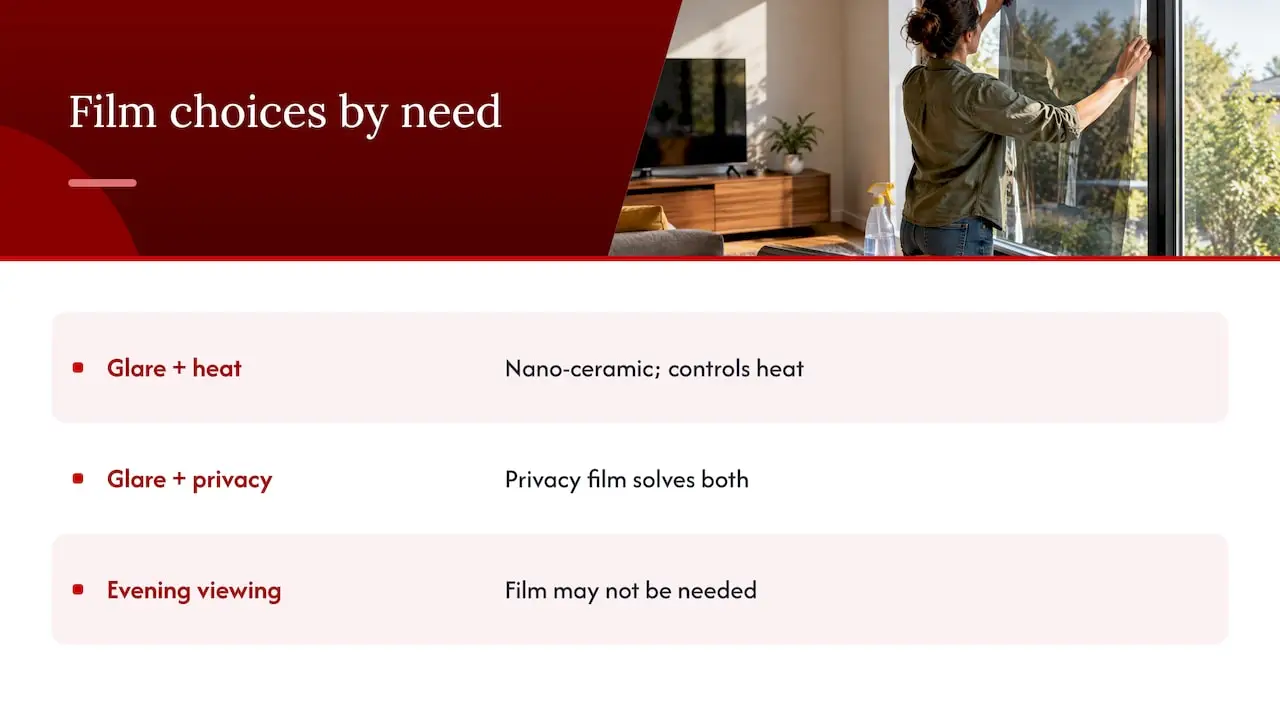
Our approach is to start with what you’re actually trying to solve. If it’s glare plus heat, a nano-ceramic film is usually the right family, because it controls heat without needing a very dark look. If it’s glare plus neighbors looking in, privacy film can solve both. And if you only watch TV in the evening, you may not need film at all.
We prefer to see the room before recommending anything: where the TV sits, which way the glass faces, what hours matter. Installation quality matters just as much as film choice. Dust, bubbles and rough edges show up badly on a large pane in direct sun, which is why we install in a controlled environment for vehicles and use pre-cut, careful methods on residential jobs. And we won’t promise a savings figure for your power bill, because the actual number depends on your house.
— Jake
Get your windows treated by a pro
If curtains aren’t the answer and you want glare, UV and heat handled in one go, our residential team can help. We offer home window tinting, including solar control, UV protection and privacy films, with lifetime warranties on installations. Tell us which window faces your TV and when you watch, and we’ll recommend a film. For a quote or to book, start at thewindowstinting.com.
And if the glare that bothers you is the one on the road, we also have a guide on cutting sun glare with anti-glare car tint.
A simple order of attack
- Today: clean the screen, switch to a daytime picture mode, and note which window causes the reflection.
- This week: rotate the TV or seating, add a bias light, and try thicker curtains on that window.
- If it’s still bad: get film samples held up to your own glass in the afternoon and compare.
- If you want it permanent: have a professional install the film, and keep the curtains for movie nights.
Most people stop at step 2. If you’re at step 3, the window is where the money is best spent.
FAQ
How can I reduce glare from my TV during the day?
First find the dominant light source by looking at the screen while it’s off. Then move the TV or seating so the window isn’t directly opposite, raise the picture brightness, and add a bias light behind the set. If one window still dominates, shade it with curtains or treat it with window film.
Is there a film I can put on my TV to reduce glare?
Yes. Anti-glare overlays diffuse reflections and can keep around 90% light transmission, according to a display film manufacturer. They can slightly soften the image and are hard to fit on large sets, so for a living-room TV many people get better results by treating the window instead.
Will anti-glare window film for a TV room make my room dark?
It depends on the film. Lighter ceramic or neutral films reduce brightness while keeping the room bright and the view clear, and darker films cut more glare but also more daylight. Check samples on your own glass at the time you watch TV before you commit.
Why do I see glare when looking at the TV screen?
Most modern TVs have glossy panels that reflect bright sources like windows and lamps, much like a mirror. Matte-screen TVs show fewer of these reflections, and the fix for a glossy one is to control the light or the angle.
Sources
- CNET: 5 Easy Ways to Get Rid of Annoying TV Glare
- Tom’s Guide: What is TV glare and how do you get rid of it?
- TCL: How To Reduce TV Glare & Reflections In Any Room
- Pro Display: Anti Glare Glass Film
- U.S. Department of Energy: Energy Savings from Window Attachments
- Federal Trade Commission: Warning letter to window marketers